Most pool landscaping ideas Golden Eagle, FL homeowners find online were written for Orlando, Sarasota or Fort Myers. Golden Eagle Plantation sits in Northeast Tallahassee, where a January freeze flattens the crotons, jade and areca palms those guides recommend. Here is what actually survives a Leon County winter, plant by plant and surface by surface.
Best Poolside Plants for Golden Eagle's Zone 8b
Start with cold hardiness, then style. Leon County sits in USDA zone 8b with pockets of 9a, which means average annual extreme lows in the 15 to 20 degree range. The USDA map is based on the average annual extreme minimum winter temperature, displayed as 10-degree zones and 5-degree half zones , and you can check your exact rating by zip code on the USDA Plant Hardiness Zone Map.
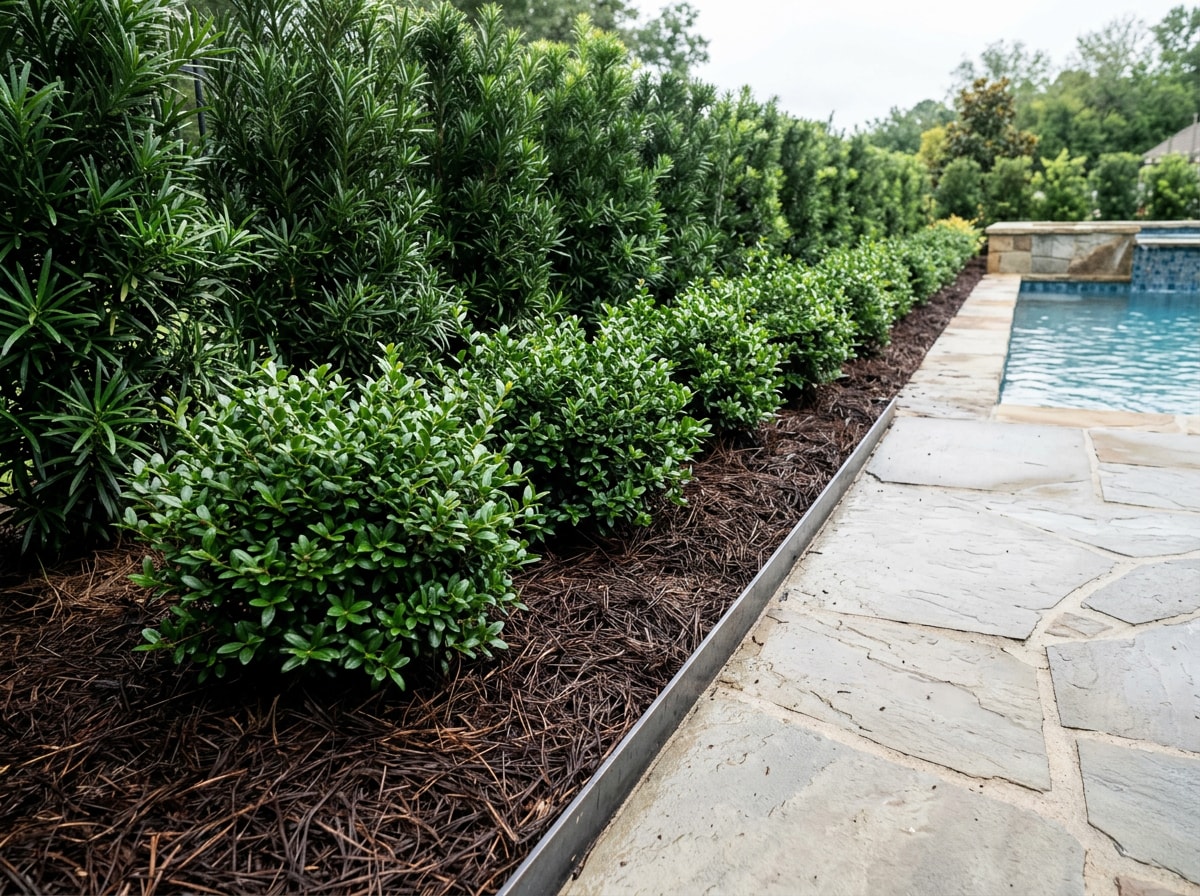
The six most reliable poolside plants we install in this neighborhood are podocarpus, dwarf yaupon holly, dwarf loropetalum, Asiatic jasmine, muhly grass and coontie. All six shed very little debris, shrug off splash-out and come back after a hard freeze.
| Plant | Sun | Mature size | Debris | Cold hardy to (approx.) | Best use near the pool |
|---|---|---|---|---|---|
| Podocarpus | Sun to part shade | 8 to 15 ft, shearable | Low | 10 to 15°F | Privacy hedge outside the cage |
| Dwarf yaupon holly | Sun to part shade | 3 to 4 ft | Very low | 5°F | Front-of-bed mass near the screen |
| Dwarf loropetalum | Sun to part shade | 2 to 4 ft | Low | 5 to 10°F | Color in the middle tier |
| Asiatic jasmine | Sun to shade | 6 to 12 in | Very low | 5 to 10°F | Groundcover in the setback strip |
| Muhly grass | Full sun | 3 ft | Low, cut back once a year | 0°F | Soft texture, fall bloom |
| Coontie | Part shade | 2 to 3 ft | Very low | 15°F | Shaded cage corners |
| Bird of paradise | Full sun | 4 to 6 ft | Moderate | 28 to 30°F | Protected south wall only |
| Croton or areca palm | Varies | 3 to 8 ft | Moderate to high | 35 to 40°F | Containers you can roll indoors |
Two notes from doing this work locally. Inside a screen enclosure, expect roughly 20 to 30 percent less light, so push borderline sun lovers toward the brightest corner of the cage. And after the January 2025 snow event in Tallahassee, the beds we rebuilt were almost all tropicals; the podocarpus and yaupon beds a few doors down needed nothing but a trim.
UF/IFAS still lists classic tropicals like croton for poolside use statewide, and notes that frosts or freezes will damage them, but they quickly recover . In 8b that recovery takes a full season, which is why we treat those species as container accents rather than bed structure. Read the UF/IFAS poolside plant list with that filter on.
Salt, Chlorine and the First Three Feet
Saltwater and heated saltwater pools are common on these lots. Salt builds up in soil over time, so the band within about three feet of the coping gets the toughest plants you own.
Asiatic jasmine, muhly grass and coontie handle that band well. Soft-leaf tropicals and most annuals do not. If you want color that close, plant it in pots you can flush or replace.
Good tree and shrub selection) is the cheapest insurance in the whole project, because a wrong plant is a removal bill later.
Set the Bed Line Back From the Screen Cage
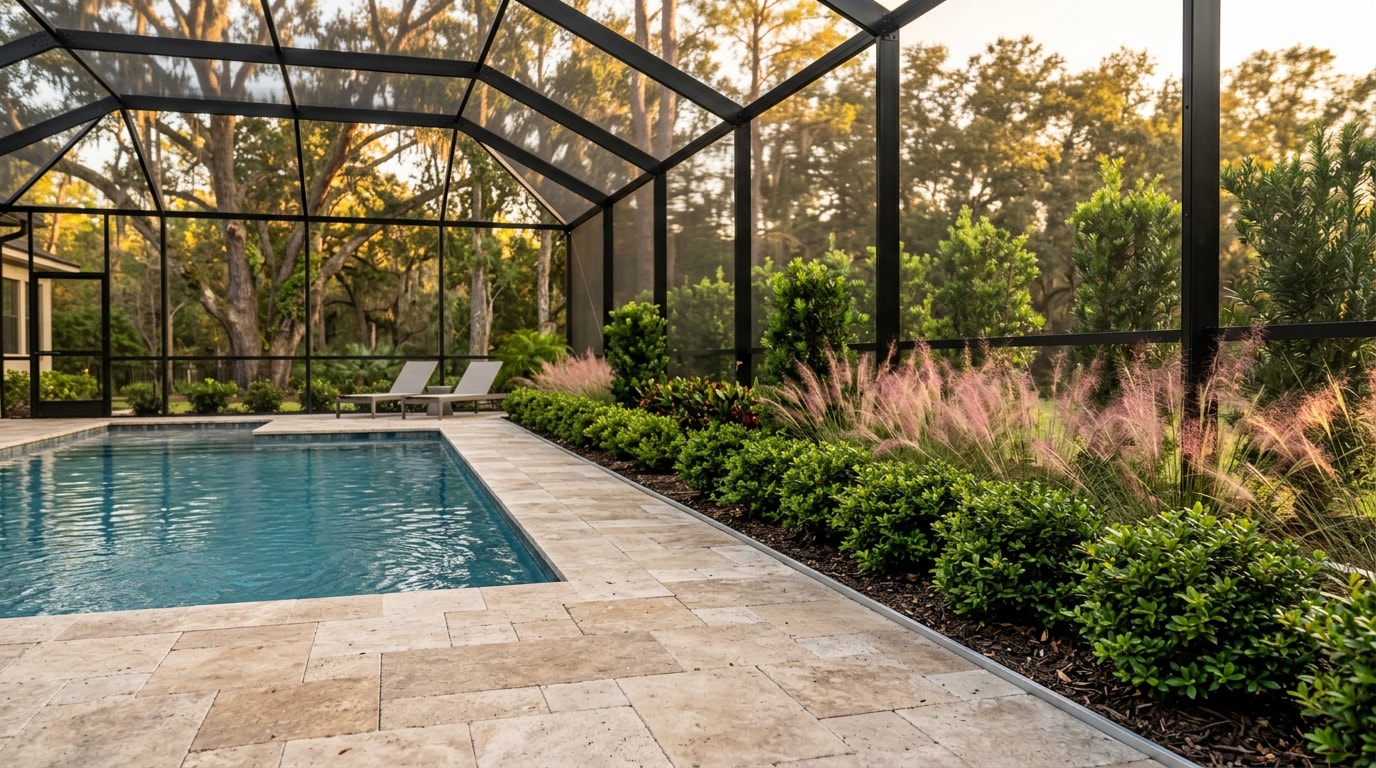
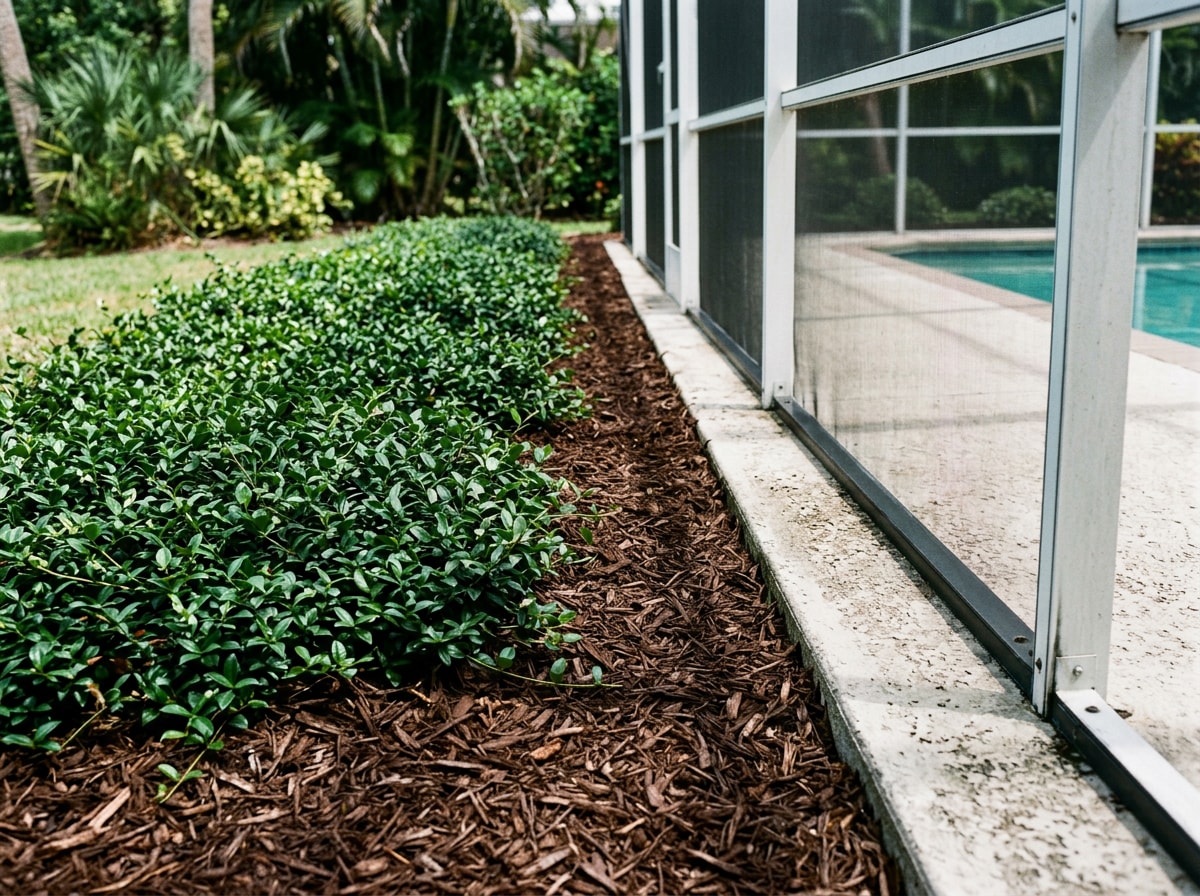
Before you shop, decide where the planting bed line starts. Pull it back off the cage and keep the strip closest to the screen simple: low groundcover, clean mulch or a tidy stone edge.
A working setback of 24 to 36 inches gives you room to walk, blow out leaf litter and reach panels for repair. Shrubs pressed against the mesh abrade it, trap wet debris and turn a 20 minute panel swap into a shovel job.
Rules vary by lot, so check the Golden Eagle HOA guidelines before planting near the enclosure. If you are not sure how far back to go, our landscape design) team marks the line on site before anything gets dug.
Layer Heights So You Do Not Lose the View
Use three tiers.
- Nearest the cage: under 18 inches, so nothing touches the mesh.
- Middle tier: 2 to 4 feet, structured plants that add fullness without reading as a wall.
- Outer edge: 6 feet and up, framing the yard rather than the pool.
The reason matters more than the rule. On Golden Eagle's golf-course and lake lots, a tall hedge in the wrong spot erases a fairway or Lake Diane view you paid a premium for.
Always shop by mature height, not nursery-pot height. A three-gallon podocarpus looks like a shrub and grows into a tree.
Privacy and Shade Without Boxing In the Pool
North Florida summer sun is brutal from May through September, so plan for both screening and shade.
Podocarpus, wax myrtle and clumping bamboo all make a living screen. A pergola or shade structure) handles the relief that plants cannot.
Here, screening usually targets a cart path, a fairway or one neighbor's sightline, not a street. That means one well-placed run of hedging), not a full perimeter.
Two local cautions. Insist on clumping bamboo varieties; running types spread under a deck and into a neighbor's yard. And set any new shade tree far enough back that a dropped limb cannot tear a screen panel in a summer storm.
Plants to Avoid Around a Golden Eagle Pool
Think in failure modes, not species lists.
- Heavy leaf drop. Deciduous trees like maple mean year-round skimming.
- Fruit. Mulberry and similar stain decking and pull in wasps.
- Thorns and sharp points. Agaves and barberry do not belong along barefoot paths.
- Aggressive spreaders. Running bamboo becomes a permanent maintenance line item.
- Invasive roots. Weeping fig and similar species lift decking and crack plumbing.
- Messy palms. Queen palm fronds and seed drop head straight for the skimmer basket.
Golden Eagle lots sit under mature live oak and pine, so the goal is manage and prune, not remove. That is partly a legal question: in unincorporated Leon County, live oaks and longleaf pines are protected at 12 inches DBH, a far lower threshold than most homeowners expect. The county notes that trees on developed lots may sometimes be removed without a permit, but site factors such as canopy road protection zones, wetlands, floodplains, slopes and the property's zoning all determine whether a permit is needed . Confirm your specific lot with Leon County Development Support and Environmental Management before any saw starts.
Where planting does not fit under a canopy, boulders, a dry creek bed or container groupings fill the space cleanly and never need pruning.
Hardscape: Decks, Water and Light
Surfaces, water and lighting are what make the space usable once the beds are in. Three elements carry most of the weight.
Pool Decking That Stays Cool and Drains
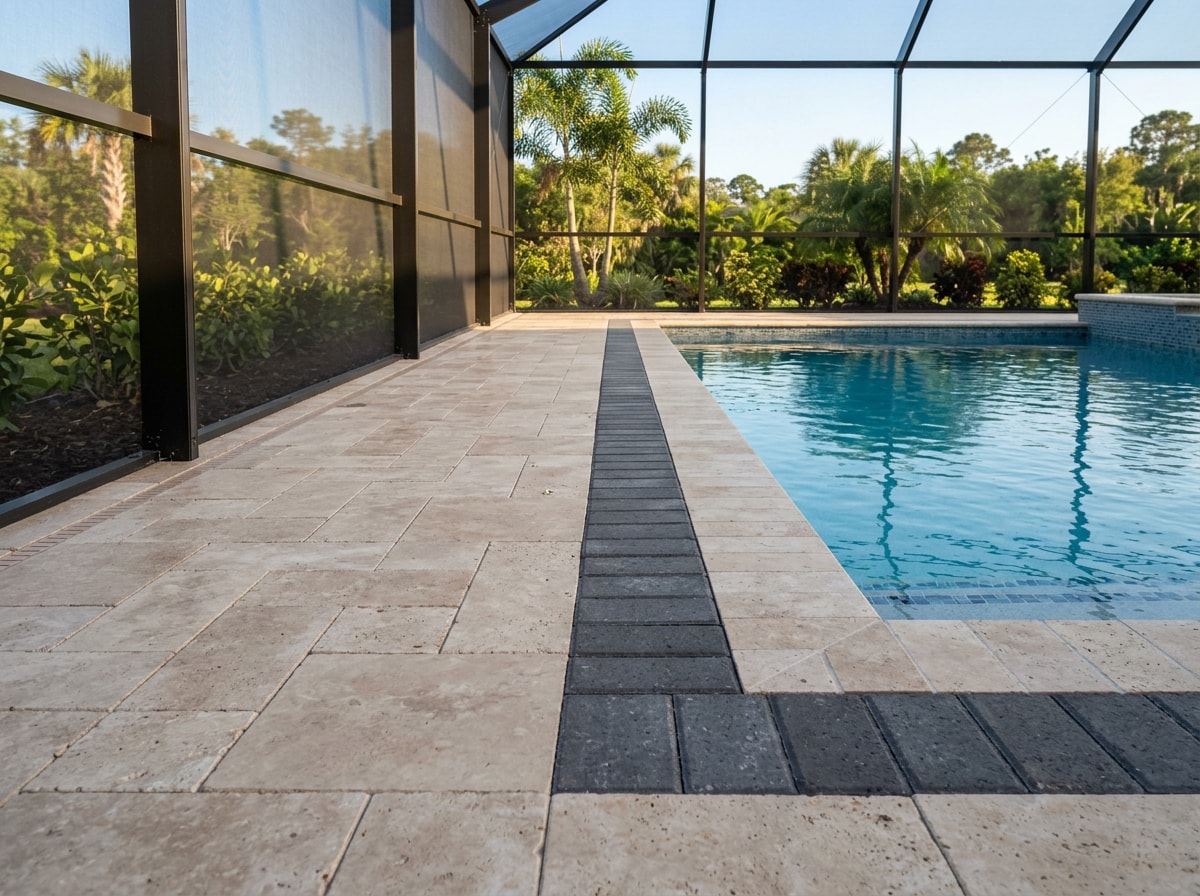
Safety and surface temperature come first. Pick a slip-resistant material that handles standing water, then worry about pattern.
| Deck material | Surface temp | Freeze-thaw behavior | Repairs | Typical installed range |
|---|---|---|---|---|
| Travertine pavers | Coolest underfoot | Good, units move independently | Lift and reset single pieces | $18 to $30 per sq ft |
| Concrete pavers | Cool to moderate | Good | Lift and reset single pieces | $14 to $24 per sq ft |
| Textured or stamped concrete | Warmest | Hairline cracking possible | Patch or resurface sections | $10 to $18 per sq ft |
Those ranges reflect what we typically quote on Tallahassee-area residential jobs in 2026; your number moves with access, demo and grade work.
Travertine already appears on many Golden Eagle lanais, which matters if you are extending an existing deck and want a match. Concrete is the budget option and gives excellent slope control for drainage), which is the detail that actually protects your beds. Pavers split the difference and are the easiest to repair, which is why paver patios) are our most common pool deck request.
One rule that overrides aesthetics: deck and fence changes must keep your pool barrier compliant. Florida law is specific that a residential swimming pool barrier must be at least 4 feet high on the outside , per Florida Statute 515.29. Raising grade next to a fence can quietly shrink that outside height. If your deck sits low and holds water after a storm, fix the grade first; our guide to a lawn leveling service in Golden Eagle covers how that work is staged.
Water Features
A sheer descent, bubbler or small waterfall adds sound and movement, and a spillover helps circulate water.
The practical split is spillover versus standalone. A feature that returns into the pool runs on existing equipment and needs no separate maintenance.
A freestanding basin fountain needs its own pump, power and mosquito management. Plumbing a spillover during a resurface costs a fraction of retrofitting one later, so decide before the pool company mobilizes. See examples of water features) we build into surrounding beds.
Outdoor Lighting
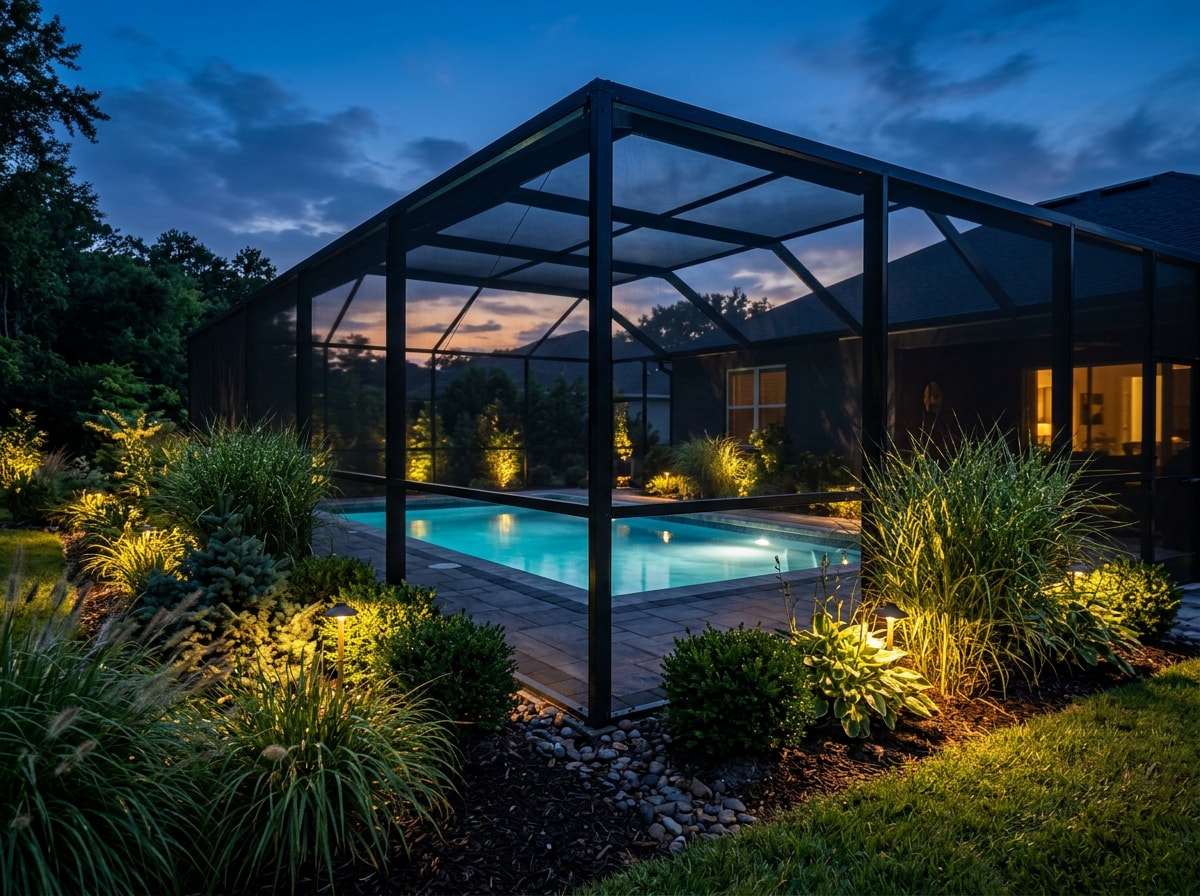
Layer LED lighting in three jobs: path and step lights for safety, uplights into shrub and palm canopies for depth, and in-pool fixtures for the water.
Inside a cage, aim fixtures into foliage, never at the panels. Mesh scatters direct light into glare and hot spots that ruin the evening look.
One caveat: any wiring near a pool is licensed electrician and permit territory, not a weekend low-voltage project.
What Pool Landscaping Costs in Golden Eagle
Homeowners ask for a number before they ask for a plan. These are the ranges we see on Golden Eagle and Bradfordville properties in 2026, installed, assuming reasonable equipment access.
| Scope | What it includes | Typical range |
|---|---|---|
| Bed refresh | Plant swap, edging, mulch, cleanup | $1,800 to $4,500 |
| Full perimeter planting | Three tiers around the cage, soil prep, irrigation) zone | $5,000 to $12,000 |
| Privacy hedge run | 40 to 60 ft of 7-gallon podocarpus, installed | $3,500 to $7,500 |
| Deck extension | 200 to 400 sq ft of pavers, base and compaction | $4,000 to $11,000 |
| Lighting package | 10 to 16 LED fixtures, transformer, licensed wiring | $2,500 to $6,000 |
Narrow gates and screened-in access push labor up fast. If a skid steer cannot reach the backyard, wheelbarrow work can add a day or two to the same scope.
Use Repetition to Make the Whole Space Feel Finished
Pick three to five reliable species and repeat them in odd-numbered groups. That rhythm is what separates a designed pool surround from a nursery clearance rack.
Bed shape does the same work. A cage has strong, clean geometry, so echo it with simple curves or deliberate angles instead of wavy edges.
Browse our recent projects to see how that plays out on real Leon County lots, or start with full-service landscaping) if you want the beds, deck and lighting handled as one build.
Plan It Once, Build It Once
Pool surrounds go wrong when plants, deck and drainage get bought separately a year apart. Sequence them together and you spend less.
Talquin Landscaping designs and installs pool landscaping throughout Golden Eagle) and Northeast Tallahassee, including beds, hedges, pavers, grading and outdoor kitchens). Ready for a plan and a number? Get a free estimate and we will walk your cage line with you.
FAQ
What are the best low-maintenance plants to put around a pool in Tallahassee?
Podocarpus, dwarf yaupon holly, dwarf loropetalum, Asiatic jasmine, muhly grass and coontie. They drop almost nothing, tolerate splash-out and survive zone 8b freezes. Save croton, hibiscus and areca palm for pots you can move indoors.
How far should plants be from a pool or screen enclosure?
Keep planting beds 24 to 36 inches off the screen frame. That strip gives you access for blowing debris, replacing panels and trimming, and it stops branches from abrading the mesh.
Can pool chemicals harm plants?
Yes. Chlorine and salt from splash-out damage sensitive species, and salt accumulates in soil around saltwater pools. Within three feet of the coping, use salt-tolerant plants only, and rinse beds with fresh water after heavy splash days.
What should I put around my pool instead of grass?
Pavers, travertine, textured concrete, river rock over fabric, or a low groundcover like Asiatic jasmine. Turf right at the coping sheds clippings into the water and is hard to mow against an edge.
What plants should you not plant around a pool?
Avoid deciduous and fruiting trees, thorny shrubs, agave near walkways, running bamboo, queen palm and anything with invasive roots such as weeping fig. Each one creates either skimmer work or structural damage.
When is the best time to plant around a pool in Golden Eagle?
October through March for shrubs and trees, so roots establish before summer heat. Warm-season groundcovers and grasses do best planted in April or May. Avoid installing tender material in December or January.
Do I need a permit for pool landscaping in Leon County?
Planting beds generally do not require one. Removing protected trees, changing grade or drainage, building structures and any electrical work usually do. Confirm with Leon County or the City of Tallahassee depending on which jurisdiction your lot falls in.
How much does pool landscaping cost in Golden Eagle, FL?
A bed refresh usually runs $1,800 to $4,500, and a full perimeter planting with irrigation runs $5,000 to $12,000. Deck, lighting and privacy hedge scopes are priced separately; see the cost table above.