River rock landscaping in SouthWood, FL solves three local problems at once: washed-out beds, mulch that disappears every summer, and side yards that stay soggy for days. It is not a universal upgrade, though, and the wrong depth or the wrong placement turns a $900 bed into a callback. Here is what it costs, how deep it needs to be, and where our crews put it on SouthWood lots.
What River Rock Landscaping Costs in SouthWood, FL
Most SouthWood quotes land in a predictable band because the lots are similar: builder-graded, tight side yards, HOA-visible front beds.
| Project | Typical size | Typical installed range |
|---|---|---|
| Front bed rock refresh | 120 sq ft | $500 to $900 |
| Foundation drip strip | 60 linear ft | $600 to $1,200 |
| Dry creek bed at a downspout | 25 to 35 ft run | $1,200 to $2,500 |
| Side yard conversion | 400 sq ft | $1,600 to $3,200 |
Those ranges include stone, fabric, edging, delivery and labor. Three things move a number up: hand-carrying stone past a locked gate, removing old mulch and roots first, and steel edging instead of plastic.
Material alone is the smaller half of the bill on most jobs. Labor and access drive the rest.
Where River Rock Works Best on SouthWood Lots
Dry creek beds and downspout runs
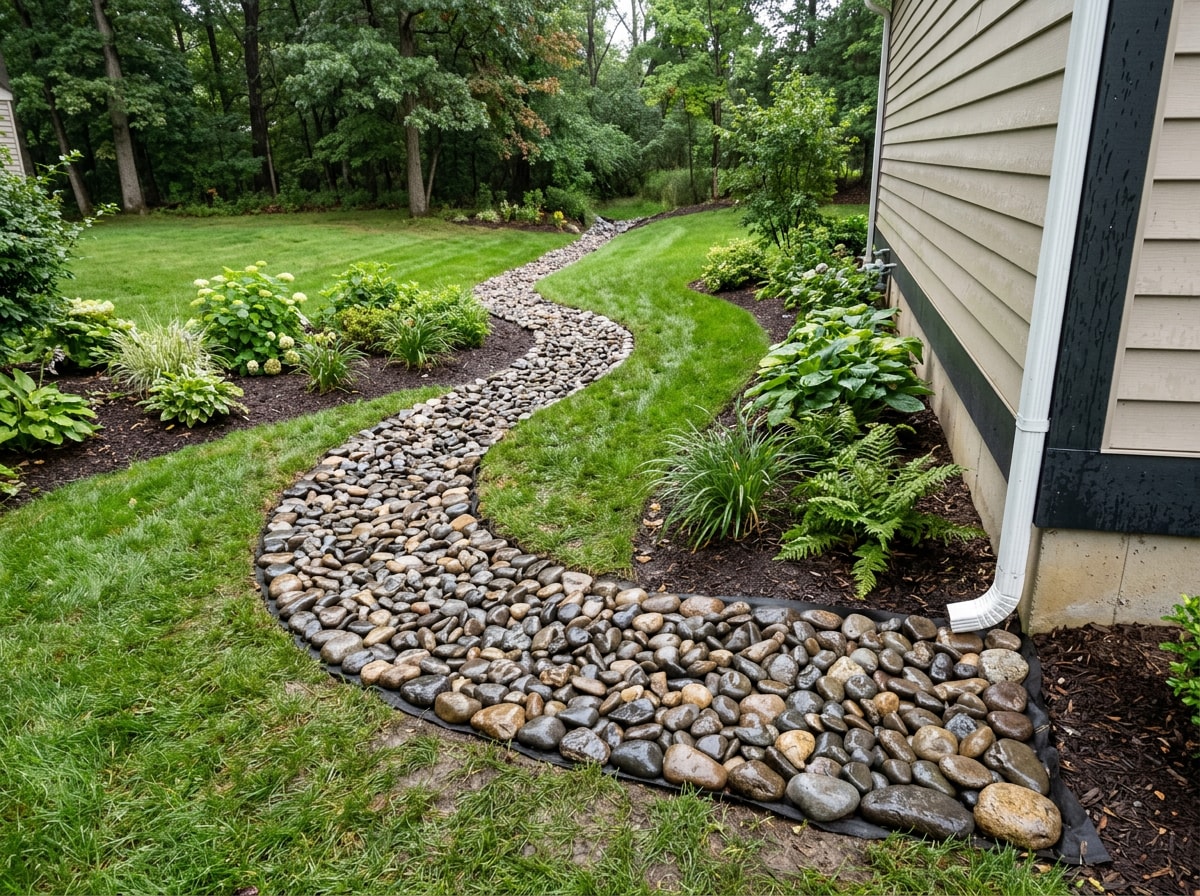
This is the highest-value use of stone here. A shallow channel catches roof water at the downspout and carries it toward a swale, an inlet or the street instead of the foundation.
Local runoff is regulated infrastructure, not just a yard nuisance. The City of Tallahassee has run a dedicated stormwater fund since 1987 covering drainage, flood prevention and surface water quality. Keeping roof water moving across your own lot keeps you out of a dispute with a neighbor or an HOA easement.
Stone channels also work because water moves through them rather than across them. EPA notes that permeable surfaces reduce runoff by letting rain seep down into underlying layers of soil and gravel.
If the water volume is too high for a surface channel, the fix is a piped system. Our drainage crews pair rock channels with French drains when roof area and slope demand it.
Foundation drip strips
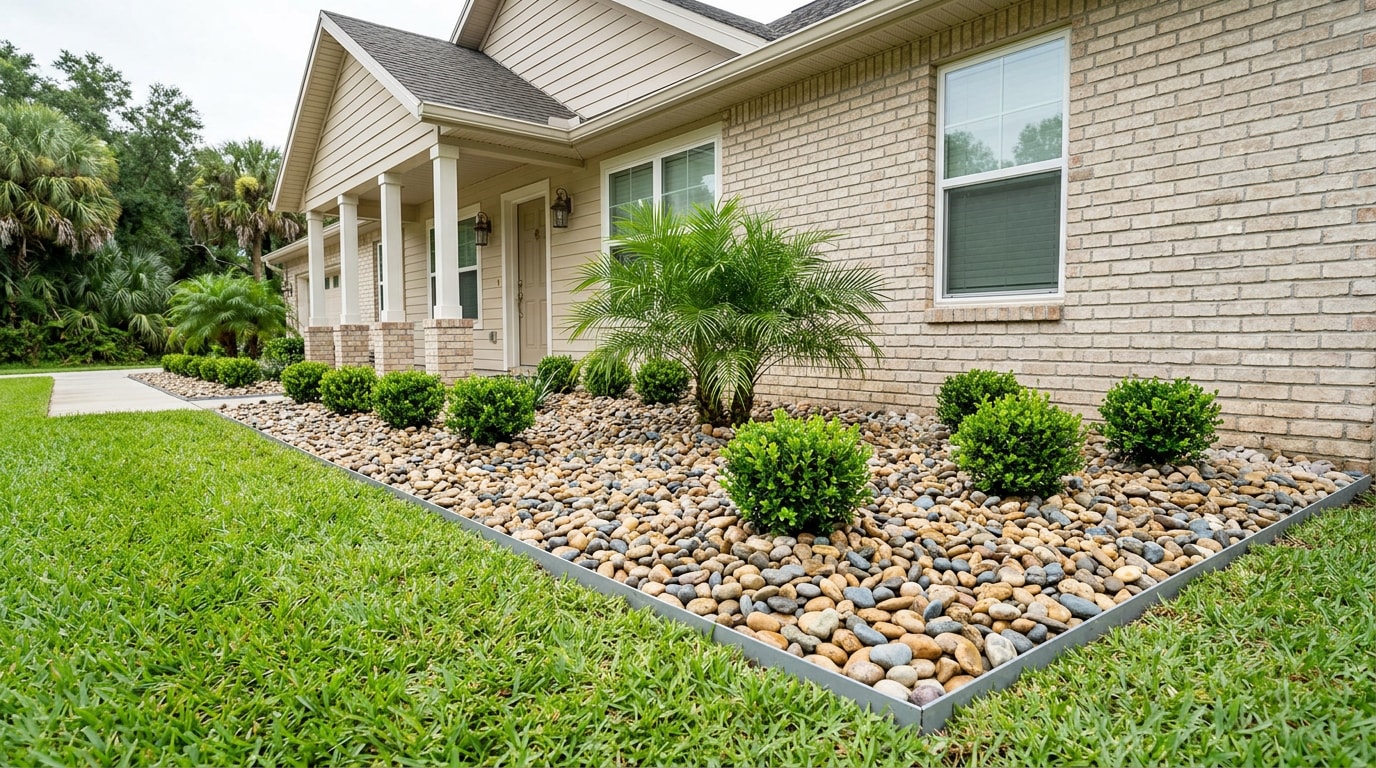
A 12 to 18 inch stone band against the slab keeps wood mulch off the house. That matters for moisture and for pests.
Pathways with steppers
Large rounded stone rolls underfoot. Nobody mentions that until they have walked it barefoot.
Set flagstone or concrete steppers at a comfortable stride and fill between them with pea gravel or 3/8 inch river rock. Save the 2 to 5 inch grades for drainage, not for walking surfaces.
Bed borders and edging
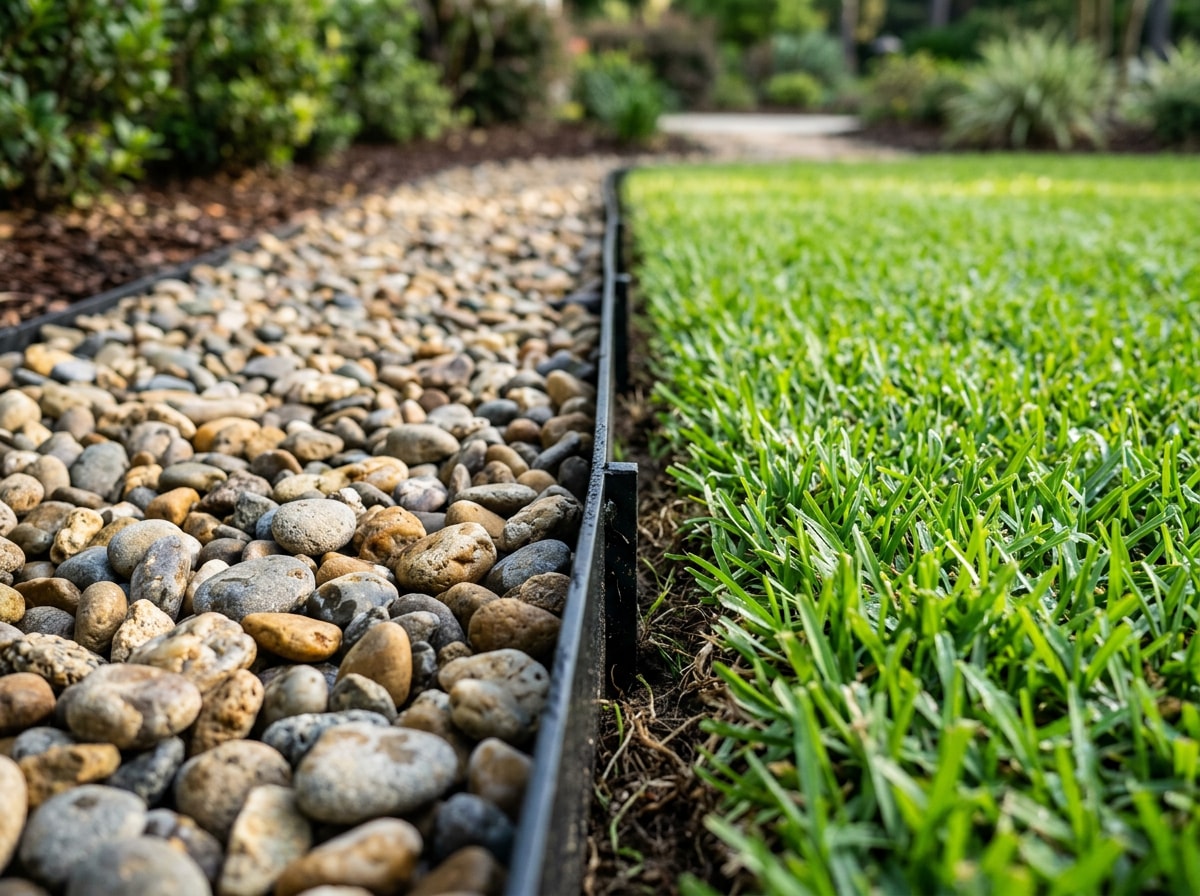
Skipping edging causes more failures than any other shortcut. Tallahassee's sandy soil moves under foot traffic, trimmer work and hard rain, and unedged stone ends up in the turf within a season.
A practical border spec is 2 inches of depth across 6 to 12 inches of width, roughly 0.015 cubic yards per linear foot. Small order, big jump in curb appeal.
How Deep Should River Rock Be?
Depth is the single most common spec error we correct on existing SouthWood beds.
| Application | Depth | Stone size |
|---|---|---|
| Decorative bed, ground cover | 2 in | 3/8 to 1 in |
| Foundation drip strip | 3 in | 1 to 2 in |
| Dry creek bed, drainage run | 3 to 4 in | 2 to 5 in |
| Path fill between steppers | 2 in | 3/8 in |
Here is the field observation behind that table. On rock beds we have been called back to inspect in SouthWood and Golden Eagle, the failures cluster in one place: 2 inch stone laid at a downspout outfall. One summer of 3 inch per hour thunderstorms scours the fabric bare and leaves a puddle in the low spot.
Three inches is the floor anywhere water concentrates. Four is better if the run carries a full roof plane.
How Much River Rock Do I Need?
Measure length times width in feet for square footage. Multiply by depth in feet. Divide by 27 for cubic yards.
Depth in feet: 2 inches is 0.167, 3 inches is 0.25, 4 inches is 0.333.
| Depth | Coverage per cubic yard |
|---|---|
| 2 in | about 160 sq ft |
| 3 in | about 108 sq ft |
| 4 in | about 81 sq ft |
Worked example: a 20 by 6 foot front bed is 120 square feet. At 2 inches that is 120 x 0.167 / 27, or about 0.75 cubic yards. Round up to a full yard for settling and edge loss.
One staging note specific to SouthWood. A cubic yard of washed river rock runs roughly 1.2 to 1.4 tons, so a three yard order is a real load on a driveway apron. Tell us where the truck can dump before delivery day, especially on narrow drives or where HOA rules limit how long material can sit out front.
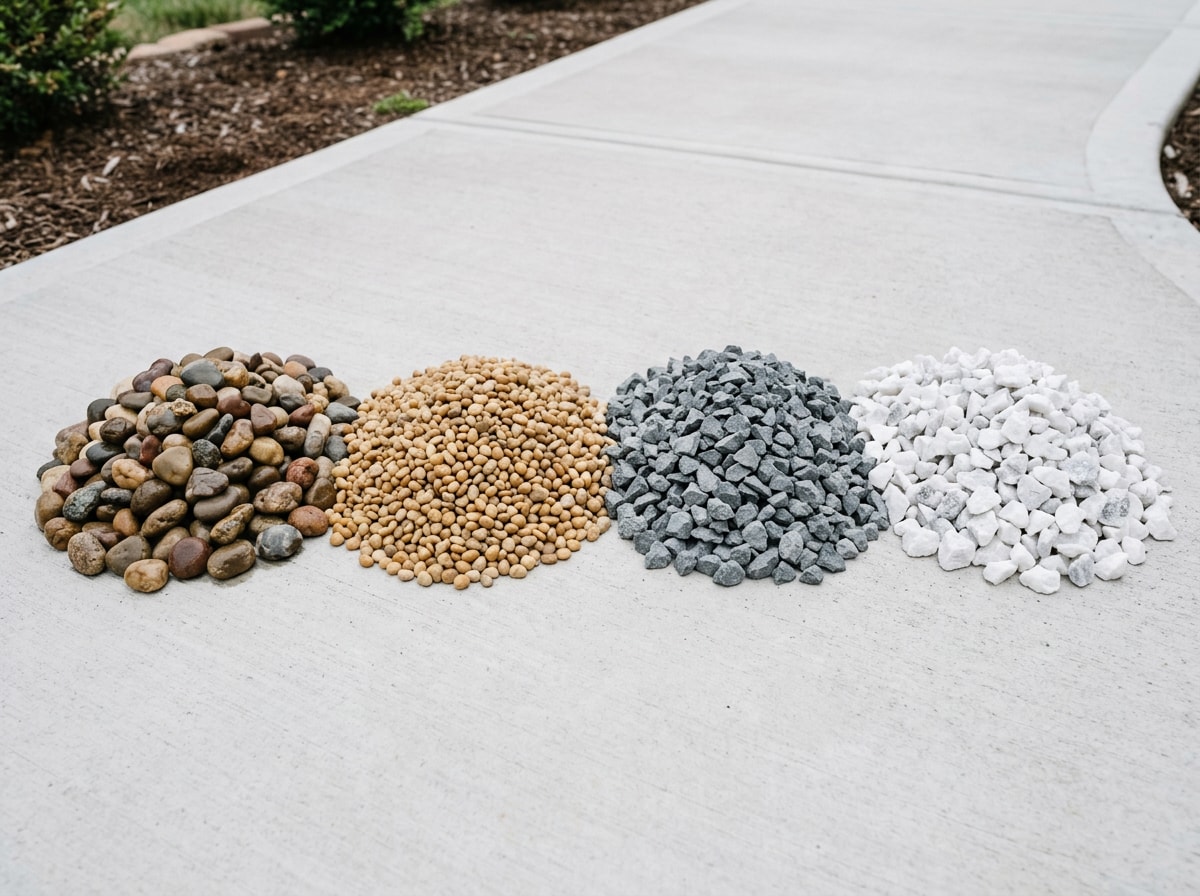
River Rock vs Pea Gravel vs Crushed Stone vs Marble Chip
| Material | Typical size | Underfoot | Drainage | Heat | Best SouthWood use |
|---|---|---|---|---|---|
| River rock | 3/8 to 5 in | Fair, rolls | Excellent | Moderate to high | Dry creek beds, drainage runs |
| Pea gravel | 3/8 in | Good | Very good | Low to moderate | Patio surrounds, path fill |
| Crushed stone | 1/2 to 3/4 in | Good, compacts | Good | Moderate | Utility paths, base layers |
| White marble chip | 1/2 to 1 in | Fair, sharp | Good | Low, reflective | Front bed accents |
River rock and pea gravel are the two most common picks locally. Crushed stone compacts and stays put, which is why it belongs under pavers rather than on top of a bed.
Matching material to placement is part of landscape design, not a supply-yard decision made at the last minute.
Stone Color and Tallahassee Summer Heat
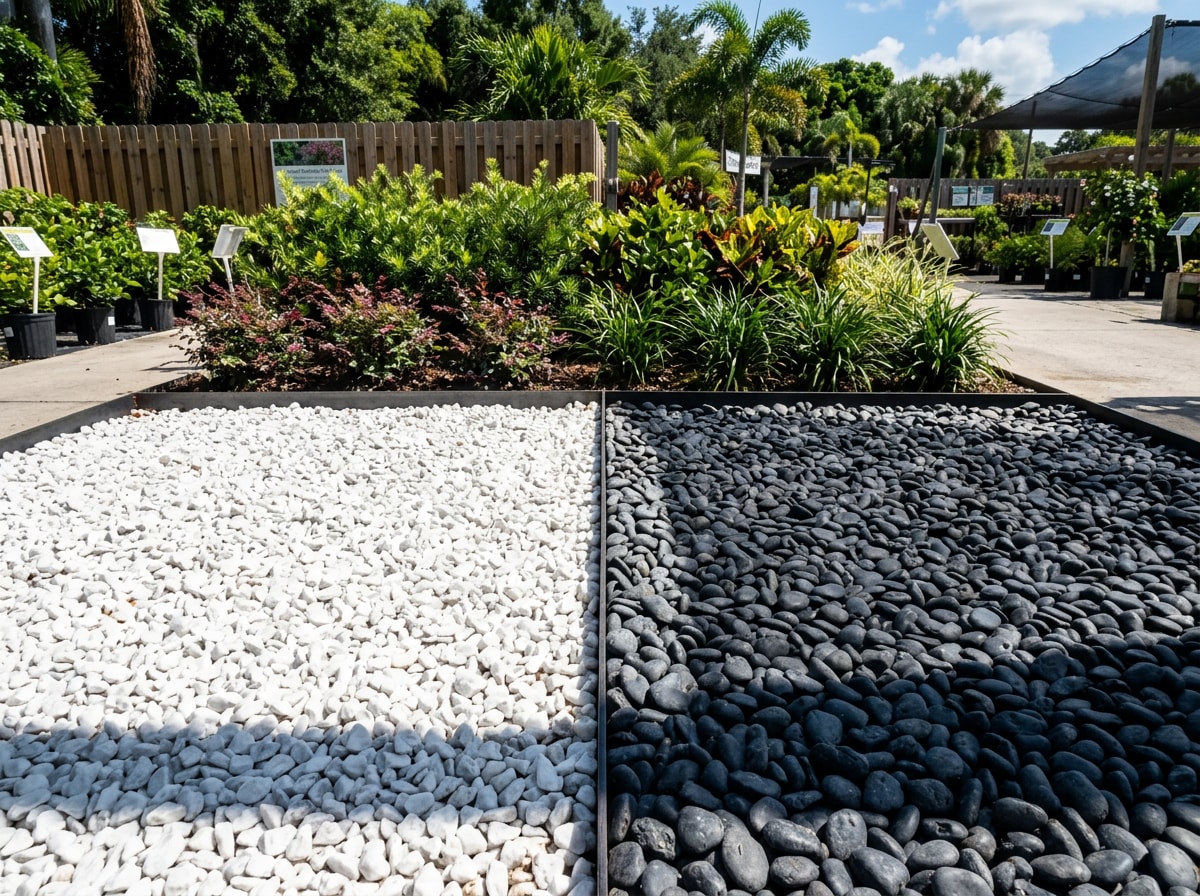
Color changes how a bed behaves in July. Light marble chip and tan pea gravel reflect heat. Dark river rock absorbs and holds it.
Barefoot traffic is the practical limit near patios and pool decks. Plant health is the other limit, and it is the reason we cap rock areas rather than covering whole beds.
UF/IFAS notes that inorganic mulches such as stone are not considered Florida-friendly because they do not contribute to soil health and often make the roots underneath too hot. Use rock where you want drainage and permanence. Use pine straw or bark where you want plants to thrive.
That split is why our landscaping crews size stone areas around the planting plan instead of the other way around.
What a Proper Install Includes
- Strip old mulch, weeds and roots down to firm soil
- Grade the area so water leaves, not pools
- Set steel, aluminum or commercial-grade plastic edging on every turf-facing edge
- Lay woven fabric on decorative beds, skip it in true drainage channels where it clogs
- Place stone to spec depth, then rake and wash it clean
- Check flow with a hose before the crew leaves
That last step is not optional on a drainage run. If it does not move water from a garden hose, it will not move water from a storm.
Rock work also pairs naturally with pavers and walls, which is covered under hardscaping. For a broader view of what a SouthWood yard typically needs, see our guide to landscaping services in SouthWood.
FAQ
Is river rock cheaper than mulch?
Not up front. Rock costs more per square foot to install, but it does not break down, so you are not rebuying it every spring. On a bed you would otherwise re-mulch twice a year, stone usually breaks even inside three to five years.
Do I need landscape fabric under river rock?
Use it under decorative beds to slow weeds and keep stone from sinking into sand. Leave it out of dry creek beds and drainage runs, where sediment eventually blinds the fabric and water backs up.
How deep should river rock be?
Two inches for decorative beds, three inches along foundations, three to four inches in any channel that carries roof or surface water.
Does river rock attract bugs?
Stone does not decompose, so it offers no food source the way wood mulch does. Along a foundation it also avoids the damp, mulch-against-siding conditions pests prefer. Insects live in every yard regardless.
Does river rock stop weeds?
It suppresses them. Seed blows in and germinates in the dust that settles between stones after a couple of seasons. Plan on spot treatment once or twice a year, which is still far less work than re-mulching.
How long does river rock last?
The stone itself lasts indefinitely. What fails is the edging and the depth. Budget for a top-up yard every five to seven years in high traffic areas.
Can I put river rock right against my house?
Yes, and it is usually the better choice there. Keep the band 12 to 18 inches wide, hold it below the weep holes or siding line, and make sure grade still falls away from the slab.
Will an HOA approve a rock bed in SouthWood?
Most front-yard changes need review. Submit the stone color, size and bed outline with your application. We can provide a simple plan sheet for that.
Get a SouthWood Rock Bed Quoted the Right Way
We measure the bed, check the fall, and tell you where stone helps and where it will cook your plants. That honesty is why most of our SouthWood work comes from neighbors of past customers.
See finished examples on our projects page, browse the full service list on our home page, or get a free estimate and we will walk the yard with you.